



Why super funds need to think differently about AI
In the first four months of 2026, Uber exhausted its annual budget for AI coding tools. Adoption was genuine: 95% of its engineers used the tools monthly and more than 10% of its code was written autonomously by AI. Yet COO Andrew Macdonald said the link between greater AI use and useful features shipped to customers was ‘not there yet’. Super fund boards will soon face the same question: are we creating value, or simply spending faster? In superannuation, this kind of waste ultimately impacts member balances and outcomes.
The Trap Is The Metric, Not The Technology
Superannuation has been here before with digital strategy: more data, touchpoints and personalised communications, accompanied by healthy adoption metrics. What often remained unclear was whether members understood their options, made better decisions or felt supported when it mattered. The technology worked; the measurement stopped at activity.
ASIC’s October 2025 review found retirement communications still dominated by one-size-fits-all messaging aimed at pre-retirees, with minimal communication for members already in retirement. Activity had not become meaningful support. AI deployed on top of that model will accelerate only part of the answer.
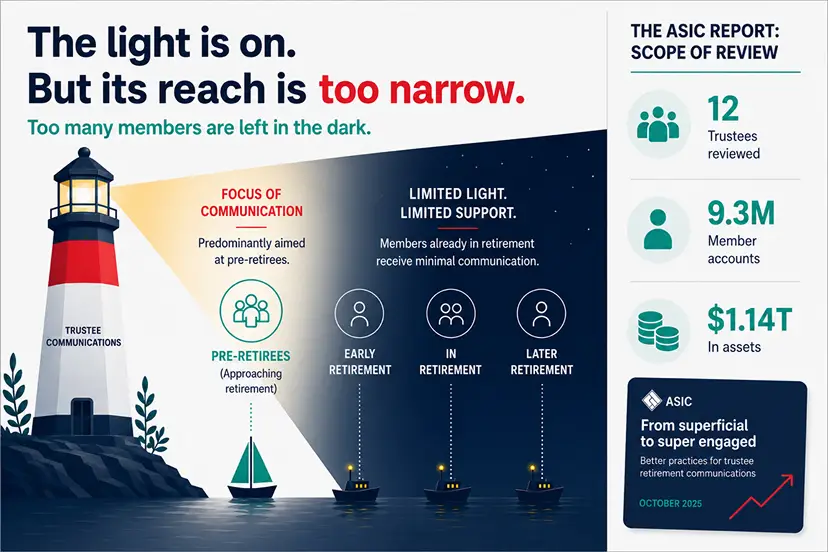
Source: ASIC, Report 818, From superficial to super engaged: Better practices for trustee retirement communications, October 2025.
Adoption is not Value
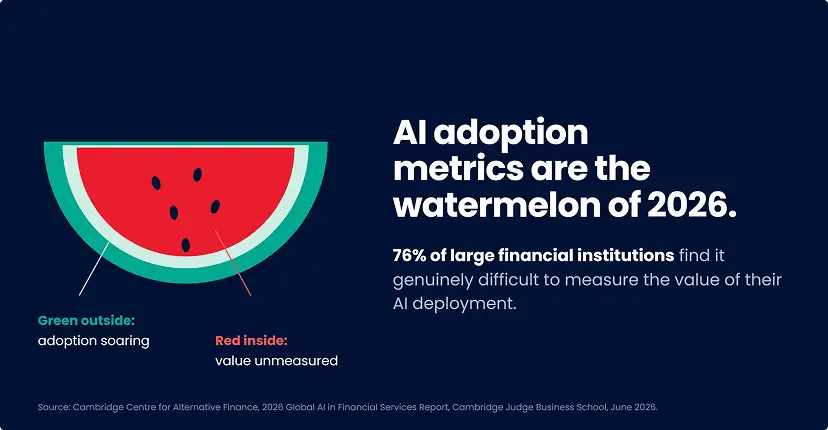
Uber’s experience is a warning precisely because adoption was so high. Spending controls arrived after the company exhausted its annual AI coding tools budget in four months. Meanwhile, the Cambridge Centre for Alternative Finance found that 55% of surveyed financial services organisations struggled to measure the value of AI deployment, rising to 76% among large institutions.
AI adoption metrics are the watermelon of 2026: 95% usage looks green from the boardroom while value remains unmeasured underneath.
APRA’s sharper expenditure scrutiny makes the board question direct: ‘What did this AI investment produce for members?’ The traps are familiar. Tools rolled out before the use case is proven; broken processes automated rather than redesigned; and governance expanded to manage spend rather than reduce it. From inside, each can look like progress.
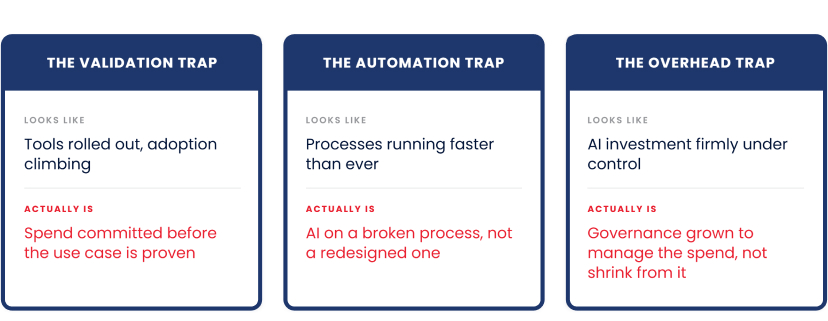
Without operating-model change, validated learning and a response to evidence, faster build cycles simply compound the original error. You discover that you built the wrong thing only after building far more of it.
Anticipatory Servicing: the Question that Changes the System
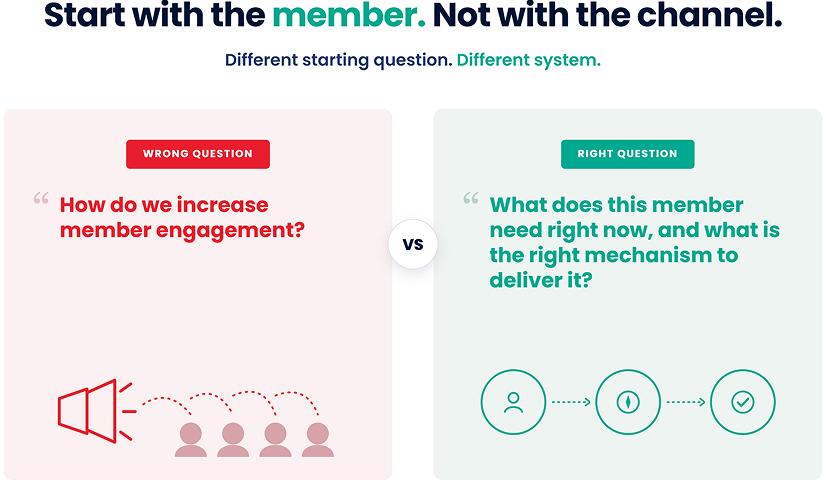
The shift super funds need to make is simple to state and hard to do. The move is from engagement: reaching members and generating interactions, to anticipatory servicing: using AI to identify when a member genuinely needs support and delivering it before they know to ask. AI makes this possible across millions of members with precision and timeliness that manual processes cannot match.
But the design logic has to start in the right place. The question cannot be “how do we increase member engagement?” It has to be “what does this member need right now, and what is the right mechanism to deliver it?” Those are different questions. They produce different AI architectures, different measurement frameworks, and different conversations with regulators.
The framing we use at IQ Group is deliberate: strategy and experimentation run in parallel, each informing the other.
Anticipatory servicing also requires data, member experience and technology to operate as one system oriented to member need. In most funds, those functions have different reporting lines, planning cycles and definitions of success. Implementations usually stall because the operating model was never updated to match the ambition, not because the technology failed.
Anticipatory servicing means AI that finds the member at the right moment and proving that the moment mattered.
At IQ Group, we believe the next phase of AI in superannuation will not be defined by adoption rates or the number of use cases deployed. It will be defined by an organisation’s ability to learn. Strategy and experimentation must evolve together, with each informing and challenging the other, creating a continuous cycle of evidence, refinement and improvement.
In that environment, anticipatory servicing becomes the true differentiator. Success comes from recognising the moments that matter, understanding the member’s likely needs, and enabling the next best conversation or action before friction, uncertainty or disengagement occurs. The outcome is not more engagement for its own sake, but more meaningful support delivered when it can have the greatest impact.
Ultimately, the winners will be the funds that use AI not to do more things faster, but to make better decisions, deliver better experiences and improve outcomes for members.
IQ Group | July 2026
Sources:
Uber Technologies, Q1 2026 prepared remarks — https://s23.q4cdn.com/407969754/files/doc_earnings/2026/q1/transcript/Uber-Q1-26-Prepared-Remarks.pdf
Andrew Macdonald interview — https://pod.wave.co/podcast/rapid-response/ubers-swerve-on-gas-prices-hotels-and-a-driverless-future-with-andrew-macdonald
Bloomberg Law — https://news.bloomberglaw.com/artificial-intelligence/uber-caps-usage-of-ai-tools-like-claude-code-to-cut-costs-1
ASIC Report 818 — https://www.asic.gov.au/about-asic/news-centre/find-a-media-release/2025-releases/25-235mr-asic-sends-clear-message-to-super-trustees-amid-glaring-retirement-communications-gaps/
Cambridge 2026 Global AI report — https://www.jbs.cam.ac.uk/faculty-research/centres/alternative-finance/publications/2026-global-ai-in-financial-services-report/
APRA expenditure outcomes — https://www.apra.gov.au/expenditure-outcomes-putting-members-best-financial-interests-first