



Lasting AI value is not created when an experiment works. It is created when the organisation develops the conditions for people to trust it, use it, challenge it, improve it and embed it into the way work gets done.
Once organisations have established a clear AI strategy and begin targeted experimentation with governance guardrails in place, the next challenge is often the hardest: making AI stick.
This is where many AI initiatives lose momentum. A proof of value may show promise. A pilot may demonstrate efficiency. A tool may produce useful outputs. But if the organisation does not change how work is done, how decisions are made, and how people build confidence with AI, the value will remain isolated. AI adoption is more than just a technology change. It necessitates changes in workforce, processes, culture, and operating approach.
That is why change enablement needs to run alongside strategy, governance and experimentation from the beginning. Its role is not simply to prepare people for the eventual implementation. It helps create the conditions in which experimentation can succeed: sufficient trust to participate, sufficient safety to challenge, sufficient capability to learn, and sufficient clarity about where the boundaries sit.
Adoption is where value becomes real
A solution may be technically sound and strategically aligned, but if people don’t understand how it helps them, where it fits into their work, or how to use it safely, adoption will often be limited. The greater risk is that uneven adoption and unintended use can undermine broader outcomes and introduce costs and risks that did not previously exist.
Change enablement bridges the gap between what AI is capable of and how work gets done. Success is rarely determined by the technology itself. It comes down to whether people understand when to use it, have an appropriately calibrated level of trust in its outputs, and know where accountability sits. The objective is neither unquestioning trust nor excessive caution. People need enough confidence to use AI, and enough judgement to recognise when it should be challenged.
That means answering a small number of practical questions:
- What is the purpose of this AI investment – does it aim to reduce cost? Improve quality for customers? Or help the company innovate into new markets?
- How does AI change the way work is performed, reviewed and approved?
- Which decisions should AI support, and which must remain with people?
- What conditions will help people experiment, challenge and learn safely — and what might prevent them from doing so?
- What skills, confidence and permission do employees need to use AI responsibly?
- How will success be measured beyond adoption metrics?
- What happens when an output appears incorrect, biased or inconsistent with policy?
These are not just change management considerations on an AI program. They are often the difference between successful adoption and another pilot that never scales.
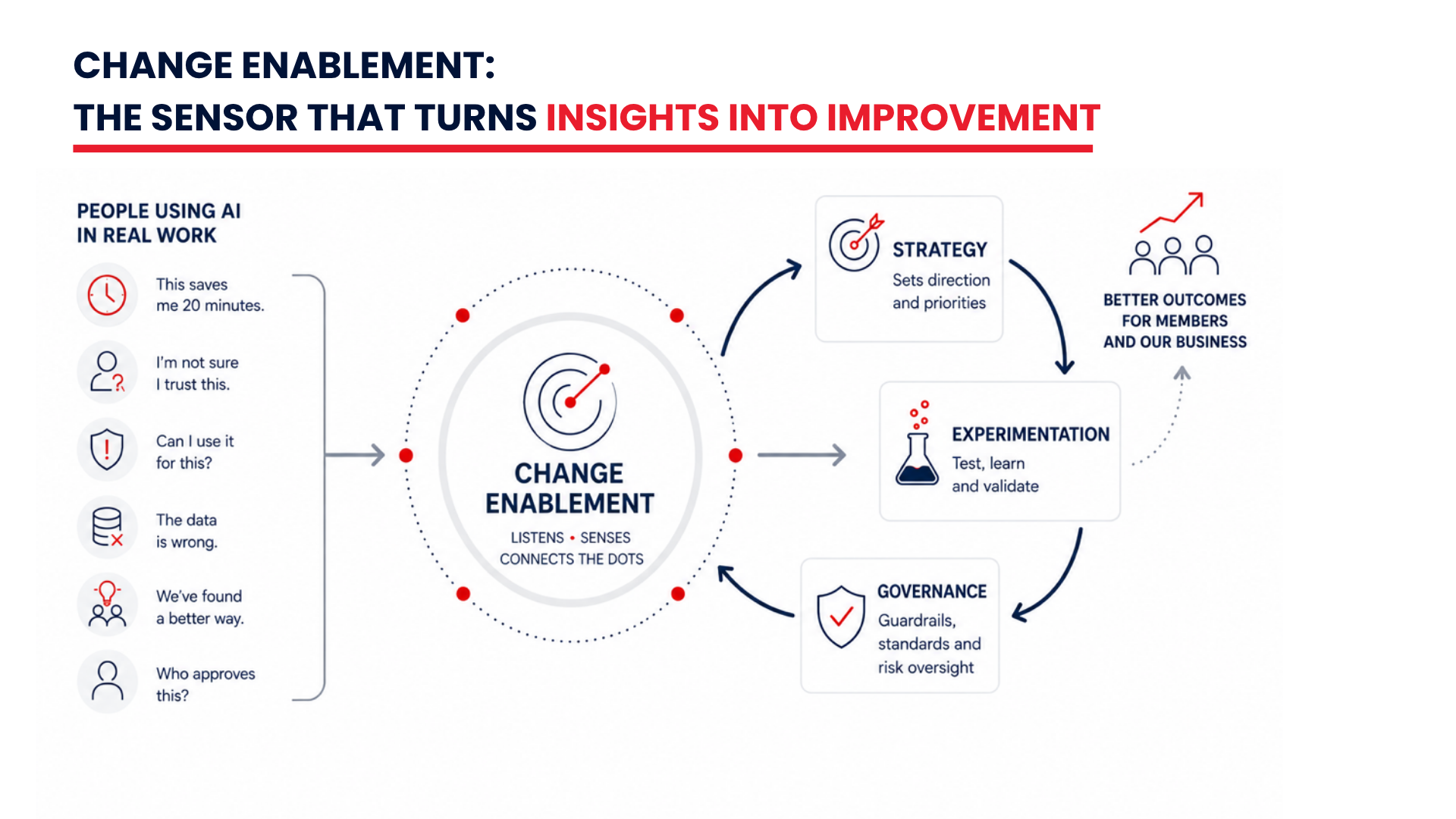
Capability needs to be built deliberately
AI adoption requires more than awareness or training. It requires people to build capability through use – experimenting, evaluating outputs, learning where AI helps and understanding where it does not.
Different business areas within an the organisation will need different levels of understanding. Executives need to know how to set direction, ask the right questions and oversee risk. Risk and compliance teams need to understand how AI changes control environments. Operational teams need practical guidance on how AI fits into processes, decision-making and member interactions. Delivery teams need the capability to design, test, monitor and improve AI-enabled solutions.
A blanket training program will not be enough. Nor should capability building be treated as a one-off intervention. As AI tools and use cases evolve, the organisation needs mechanisms for people to learn from each other, share emerging practices and continuously recalibrate how AI should be used.
This includes building AI literacy, but it also includes shifting behaviour. People need to become comfortable critically evaluating AI outputs. They need to understand when to trust, when to challenge, when to escalate and when human judgement must override the system.
In regulated environments, confidence cannot mean unquestioned reliance. It must mean informed use.
Change enablement is part of the learning loop
When teams use AI in real-world settings, they generate practical insights that may not be captured in a workshop or strategy document. They identify process gaps, data issues, workflow friction, capability needs and trust barriers. They also identify where AI creates unexpected value. Change enablement also provides an important sensing mechanism. Adoption patterns, hesitation, workarounds, misuse and frontline feedback are not simply “resistance” to be managed. They are signals about whether the solution, controls, process or organisational environment needs to change.
That feedback should not stay at the frontline. It should flow back into the AI strategy, governance model and experimentation pipeline.
This is how organisations move from one-off pilots to repeatable capability. Each implementation teaches the organisation something. Each learning improves the next decision. Each adoption challenge becomes an input into better design. Change enablement is part of the AI operating system.
Culture matters as much as control
Governance provides guardrails but culture determines how people behave within them.
If people are afraid to use AI, the organisation will move too slowly. If people use AI carelessly, the organisation may move too quickly in the wrong direction. The goal is to create a culture where people are curious, careful and confident. The goal is not simply maximum adoption. It is the right conditions for responsible adoption as AI is being introduced to improve member outcomes, remove friction, strengthen decisions and create better ways of working.
It also requires psychological safety. People need to be able to challenge an AI output, raise concerns, admit when an experiment has failed and share what they have learned without fear. In AI-enabled environments, these behaviours are not simply cultural niceties; they are part of the control environment.
The strongest organisations will be those who learn quickly, adapt openly and build confidence through evidence. In AI transformation, resistance should not automatically be treated as a barrier to adoption. It can be valuable data in itself. Hesitation may reveal a poorly designed workflow, insufficient explanation, inappropriate controls, lack of trust in the underlying data or a legitimate concern about accountability.
Embed, measure and improve
For AI to become sustainable, organisations need to measure more than deployment activity. They need to measure whether AI is creating the intended value.
That means tracking adoption, usage quality, process impact, member outcomes, risk events, workforce confidence and operational improvement. It also means being prepared to refine or stop solutions that are not delivering the desired value.
Measurement should also tell leaders something about the organisational environment around AI. Are people avoiding approved tools? Over-relying on them? Are they creating workarounds? Are they escalating appropriately? Sharing lessons? These signals help leaders determine whether the organisation needs more freedom, more capability, clearer guardrails or stronger controls.
Change enablement should support this discipline. It should help define what good adoption looks like, what success measures matter, and how feedback is captured over time.
The question is not simply, “Has the AI solution gone live?”
The better question is, “Have we created the conditions in which people can use, challenge and improve this capability — safely, confidently and continuously?”
Because making AI stick is ultimately less about managing a technology change and more about building an organisation that is capable of continuous change.
IQ Group perspective
At IQ Group, we believe AI change enablement is where ambition becomes capability. Strategy creates direction. Experimentation tests where value can be created and informs what comes next. Governance provides the guardrails for responsible use. Change enablement creates the conditions for people to adopt, challenge, learn from and continuously improve AI as part of the way work gets done.
This is especially important for financial services, where AI needs to deliver better client and member outcomes while maintaining operational resilience, appropriate controls and regulatory confidence. The organisations that lead with AI will not be those with the most pilots, they will be those that create the conditions to learn quickly, adapt safely and turn each implementation into capability for the next.
AI’s value emerges when people know when to use it, when to challenge it and how to improve it through experience. That requires more than managing individual changes; it requires building an organisation capable of continuous change.
That is how AI moves from experiment to capability and how early momentum becomes lasting value.
IQ Group | September 2026
Influenced by: The Goldilocks Zone: How Leaders Build the Conditions for Continuous Evolution. Craig Kimball and Nadir Khan present the concept of “climate management” — creating the organisational conditions in which people can continuously adapt and change — has informed the thinking in this article, particularly the role of change enablement in calibrating trust, capability, learning and adaptability around AI.